


Why Your Knees and Hips Hate Sandbag Lunges (And What to Do About It)
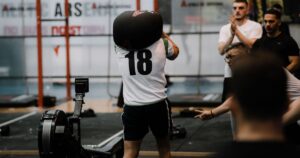
Ask anyone who has done Hyrox what the hardest station was. A lot of people will say the sandbag lunges. One hundred metres of weighted isolated leg work, being the second to last of the eight stations, when the legs are already tired from the prior six stations, primarily the sleds, and seven kilometres of running.
For many athletes, particularly in the weeks of training leading up to a race, this is where knee and hip pain shows up. Here is what is happening and what actually helps.
Why the Knees Take the Hit
The lunge is an alternating single-leg focused exercise, however work is produced in different ways for both legs in the execution of a single lunge. All your bodyweight plus the sandbag is going through both knees, but the majority of the load goes through the front leg on each lunge, this results in a concentric and eccentric phase of loaded work on the muscles and attaching tissues surrounding the knee and hip joints throughout the movement. Due to the alternating of legs, this automatically places more strain on the knees and hips in order to maintain balance through movement from one leg to the other with added weight.
The patellofemoral joint, the interface between your kneecap and the femur behind it, takes on significant compressive load. Under fatigue, when the glutes and hip stabilisers are no longer doing their job properly, the knee tends to track inward. That altered alignment increases stress on the medial structures and can cause or aggravate pain around the kneecap, inner knee, or IT band.
The hips suffer for similar reasons. Loaded lunges under fatigue put the hip flexors through repeated eccentric stress. If the warm-up was insufficient, or if the lunges come straight after a tough sled push, the hip flexors and glutes will make their feelings known the next morning.
Prehab: The Work That Prevents the Problem
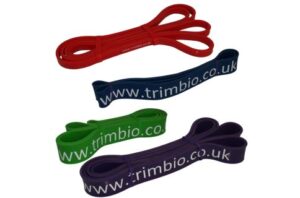
The most effective intervention is before pain starts. Resistance band work targeting the glutes and hip abductors and flexors is well-supported by sports therapy practice for reducing knee pain in loaded single-leg movements. Lateral band walks, clamshells, and terminal knee extensions build the stability that keeps the knee tracking correctly when it matters.
Resistance loops are ideal for this. Light to medium resistance for warm-up activation, heavier for dedicated strength work. A set takes up almost no space and covers the full range of exercises.
 |
| Shop: Resistance loops at trimbio |
Managing Pain During a Training Block
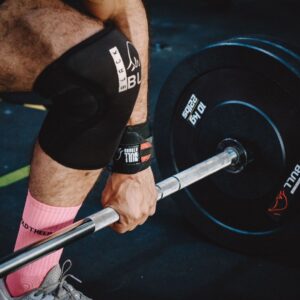
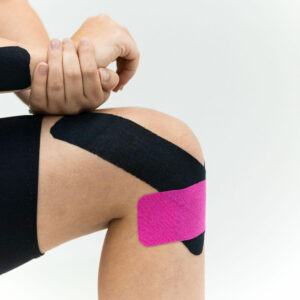
If the knees are already sore, a knee support reduces patellofemoral compression and provides proprioceptive feedback that helps the joint track more efficiently. Kinesiology tape is another option. A patella tendon application reduces load through the tendon during movement and can improve tracking through both training and racing.
 |
 |
| Shop: Knee support at trimbio | Shop: Kinesiology tape at trimbio |
After the Session
Cold therapy in the first 24 to 48 hours reduces swelling around the knee joint. An instant ice pack for 15 to 20 minutes after a hard session is a practical and effective step. Reusable gel packs are the better option across a full training block.
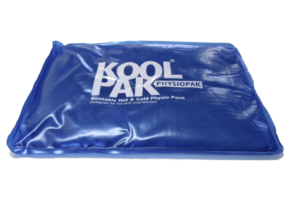 |
| Shop: Cold packs at trimbio |
Persistent or sharp knee pain is worth getting assessed. A sports therapist or physiotherapist can identify whether the issue is patellofemoral, IT band related, or coming from further up the chain in the hip.
For a full view of Hyrox preparation, including training kit, race day packing, and recovery, head back to the main guide.
Back to pillar: Are You Ready for Hyrox? The Complete Preparation Guide
If race day is getting close, this is worth reading next.
Read next: What to Pack in Your Hyrox Race Day Bag
Keep your knees and hips training-ready. Shop resistance loops, kinesiology tape and knee supports at trimbio.co.uk.