

Free Delivery over £75 ex VAT
*Excl. Reconditioned Equipment & Medical Furniture

Payment Options Available
We accept Klarna, VISA, Mastercard & AMEX

UK Offices & Warehouse
Dispatched within 2 days. Next-day upgrade:£2.99+VAT

Proud Supplier to the NHS
To Trusts across the United Kingdom
Biofeedback / EMG

Biofeedback / EMG
EMG biofeedback uses sensors placed on the skin to give real-time visual and audio feedback on muscle activity, helping patients learn to control and improve muscle function. It's used in stroke rehabilitation, pelvic floor therapy and chronic pain management. Single-channel units, like the Simplex and MyoPlus PRO, suit straightforward training on one muscle group. Multi-channel Bluetooth units, the MyoPlus 2 PRO and MyoPlus 4 Pro, add simultaneous monitoring across two or four channels plus software for tracking patient progress over time, better suited to clinical assessment and reporting. Not sure which fits your practice? Get in touch, and the team can talk you through it.
EMG Biofeedback uses sensors to give real-time visual and auditory feedback on muscle activity, helping patients learn to control and optimize muscle function. It’s a non-invasive way to improve strength, coordination, and relaxation—commonly used in stroke rehab, pelvic floor therapy, and chronic pain management.
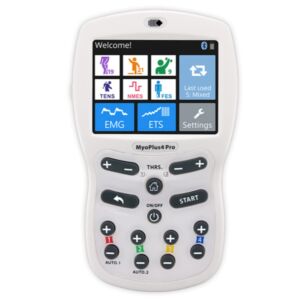
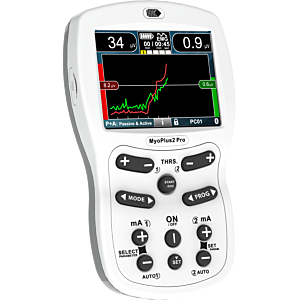
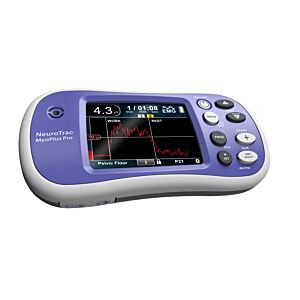
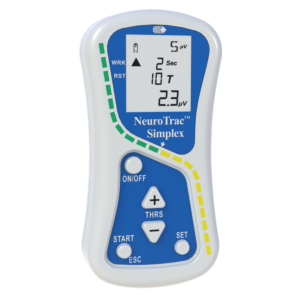


What is EMG biofeedback?
EMG biofeedback is a way of making muscle activity visible. Small sensors are placed on the skin over a muscle, and the device picks up the tiny electrical signal the muscle produces when it contracts. That signal is shown on a screen, or as a sound, so the patient can see or hear their own muscle working in real time. This matters because many patients can't feel a weak or poorly controlled muscle well enough to retrain it by instruction alone. Seeing the signal gives them something concrete to aim for, tightening a pelvic floor muscle, or relaxing a muscle that's gone into spasm, and lets the practitioner track progress objectively rather than by feel.
Is EMG biofeedback the same as biofeedback for stress or anxiety?
No. General biofeedback can also measure heart rate, breathing or skin conductance, and is often used for stress and anxiety. EMG biofeedback specifically measures muscle electrical activity, and in a clinical setting is used for muscle retraining, not relaxation or mental health support.
EMG Biofeedback FAQs
What is EMG biofeedback used for?
It's used in stroke rehabilitation to help patients regain control of affected muscles, in pelvic floor therapy to help patients learn to correctly contract or relax the pelvic floor, and in chronic pain management to reduce muscle tension patients may not otherwise be aware of.
What's the difference between single-channel and multi-channel EMG biofeedback?
A single-channel unit monitors one muscle group at a time, straightforward and lower cost, well suited to a single treatment focus like pelvic floor training. A multi-channel unit monitors two or more muscle groups simultaneously, useful for comparing muscle balance or tracking a more complex rehabilitation programme.
Do I need Bluetooth and software with my EMG biofeedback unit?
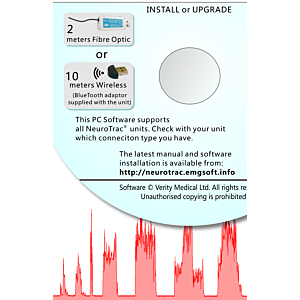
Bluetooth and the accompanying software let you log and review a patient's progress over multiple sessions, useful for clinical reporting and for demonstrating improvement over time. A standalone unit without software still gives real-time feedback during the session itself, it just doesn't retain the session history.
What is surface EMG, and is it different from EMG biofeedback?
Surface EMG (sEMG) is the underlying measurement, picking up a muscle's electrical activity through sensors on the skin rather than needles inserted into the muscle. EMG biofeedback is surface EMG used specifically to give the patient feedback they can act on during treatment.
Can EMG biofeedback be used at home as well as in clinic?
Yes, several of the units we stock are suitable for home use between clinic sessions, useful for patients continuing a pelvic floor or muscle retraining programme independently. Your practitioner can advise which unit suits home use.
Can't find what you need? Call our team on 01403 597 597 or contact us online.