


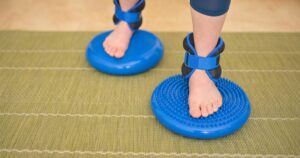
Using a Wobble Cushion for Ankle Rehabilitation
Ankle sprains are one of the most commonly presenting musculoskeletal injuries in clinical practice, and one of the most frequently under-rehabilitated. Restoring strength is only part of the job. Proprioceptive deficits often persist long after the structural healing is complete, and without addressing them, re-injury rates remain high.
A wobble cushion is one of the most practical tools for targeting this. It introduces a controlled proprioceptive challenge that can be scaled to the stage of recovery, prescribed for home use, and progressed without specialist equipment.
Ankle rehab: where the wobble cushion fits
Wobble cushion work typically begins in the mid-phase of ankle rehabilitation, once the patient has adequate pain-free weight-bearing and basic strength is returning. In the early acute phase, it is generally too demanding; the focus there is on swelling management, range of motion, and gentle weight-bearing.
A reasonable guideline for lateral ankle sprains is to introduce the wobble cushion from around 2–3 weeks post-injury for Grade I–II injuries, or when weight-bearing is comfortable without a limp.
Progression for ankle rehab
The following progression follows standard principles for neuromuscular rehabilitation after ankle injury.
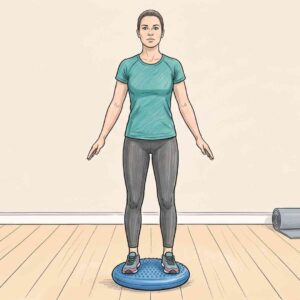 |
Stage 1: Two-legged standing (eyes open) Both feet on the cushion. Focus on maintaining a level pelvis and avoiding compensatory trunk movement. 3 x 30–60 seconds. |
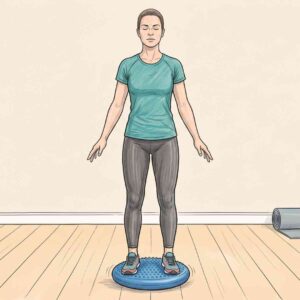 |
Stage 2: Two-legged standing (eyes closed) Removing visual input increases reliance on the proprioceptive system. A substantial step up in difficulty from Stage 1. 3 x 20–30 seconds. |
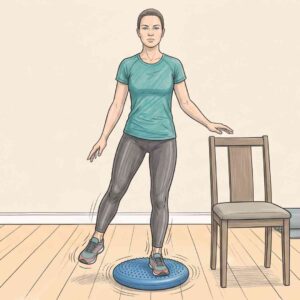 |
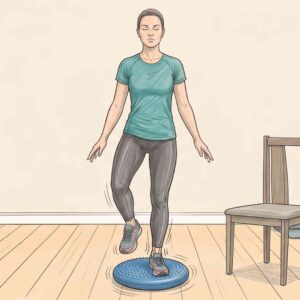
Stage 3: Single-leg stance (injured side, eyes open) The real work begins here. 3 x 15–30 seconds. Have a support within reach. Encourage the patient to tolerate the wobble rather than fight it — the ankle stabilisers activate best when the movement is allowed. |
 |
Stage 4: Single-leg stance (injured side, eyes closed) Only when Stage 3 is well controlled. 3 x 15–20 seconds. |
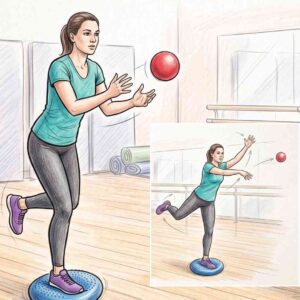 |
Stage 5: Dynamic challenge on single leg Introduce a task: catching and throwing a ball, head turns, reaching out with the free hand. This replicates the dual-task demands of real-world activity and is a good functional endpoint for most patients. |
Chronic ankle instability
For patients presenting with chronic instability, repeated sprains, giving-way episodes, and lack of confidence on uneven ground, proprioceptive training is the primary intervention. Wobble cushion training used consistently over 6–8 weeks produces measurable improvements in dynamic balance and self-reported instability.
This population often benefits from a maintenance programme of balance training even after discharge, which a home wobble cushion supports well.
Browse wobble cushions at trimbio
For a full overview of wobble cushion exercises across different presentations, see the wobble cushion rehabilitation guide.