



Wobble Cushions vs Balance Pads: Which is Best for Proprioception Training?
Wobble cushions and balance pads both train proprioception, and clinics often end up owning both, but they suit slightly different patients and stages of a rehab programme. Here is a clear, practical comparison to help you decide which to reach for, and when.
What is proprioception?
Proprioception is the body's sense of where its joints and limbs are in space without needing to look, built up from constant feedback from receptors in the muscles, tendons, and joints themselves.
Training it helps reduce injury risk and improve control during movement, particularly after an injury has disrupted the normal feedback loop between a joint and the brain, which is a well recognised part of why balance retraining matters so much in rehabilitation.
What is a wobble cushion?
| A wobble cushion is a round, air-filled disc that creates multi-directional instability, commonly used for standing and seated balance work, and capable of tipping in any direction depending on how weight is shifted across it.
Because the instability is unpredictable, it demands constant, active correction from the user, which is part of why it is often introduced once basic balance control has already been established through gentler equipment. |
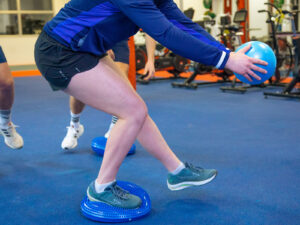 |
| Wobble Cushion |
What is a balance pad?
| A balance pad is a dense foam mat that creates instability through an uneven, compressible surface rather than a moving disc, offering a softer and often less intimidating starting point for someone new to balance training.
Because the surface compresses rather than tips dramatically, it tends to feel more forgiving underfoot, which matters for patients who are anxious about falling or who are at an earlier, more cautious stage of their rehab. |
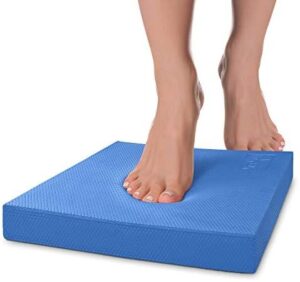 |
| Balance Pad |
Head to head comparison
Surface type, difficulty level, best use case, and price range all differ between the two options. Wobble cushions typically offer a greater range of dynamic instability and are generally considered the more advanced tool of the two.
Balance pads offer a gentler, more forgiving surface and tend to be the more accessible entry point, particularly for patients who are older, more deconditioned, or earlier in a post-surgical recovery timeline.
Wobble cushion strengths
Wobble cushions work well for ankle rehab, seated active use, and dynamic instability training where a greater balance challenge is appropriate for the patient's current stage of recovery.
They are often used with athletes returning to sport, where the goal is to closely replicate the unpredictable, multi-directional demands the body will face back on the pitch or court.
Balance pad strengths
Balance pads offer a softer landing surface for elderly or post-operative patients, a wider surface area for confidence, and a less intimidating introduction to balance training generally.
They are also a practical choice for group or class settings, where a range of patients with different confidence levels need a piece of equipment that feels approachable rather than daunting from the first session.
Which is better for ankle rehab?
Wobble cushions are often preferred for ankle rehab due to the greater range of multi-directional movement they demand, which closely mirrors the kind of unpredictable surface challenges that led to the original injury in many cases.
That said, a balance pad is often used in the very earliest stage of ankle rehab, before progressing to a wobble cushion once basic stability and confidence have been rebuilt.
Which is better for knee rehab?
Balance pads can be gentler on the knee joint during early-stage rehab, offering a stable enough surface to build confidence without excessive joint stress, with wobble cushions introduced as strength and confidence improve.
As a patient's knee rehab progresses towards return to sport or high-level function, a wobble cushion adds a valuable layer of unpredictability that a balance pad alone cannot fully replicate.
Which is better for elderly or neurological patients?
Balance pads are generally the safer starting point for elderly or neurological patients due to the more stable, forgiving surface, and the lower risk of a sudden, unexpected tip that could cause a fall.
For these patient groups, progression to a wobble cushion, if appropriate at all, should be gradual and closely supervised, reflecting the higher fall risk typically present in these populations.
Can you use both together?
Yes, many rehab programmes use a balance pad in early stages before progressing to a wobble cushion as balance control develops, creating a clear, logical progression pathway through a course of treatment.
Some advanced programmes even combine the two, for example, standing with one foot on each surface, to create an asymmetric challenge once a patient is ready for a more demanding stage of rehab.
FAQ
Which is safer for beginners?
Balance pads are generally considered the safer starting point due to their softer, more forgiving surface, which reduces the risk of a sudden loss of balance compared with the more dynamic tip of a wobble cushion.
Can both be used for core training?
Yes, both challenge the core to stabilise the body, though the wobble cushion tends to demand more active, continuous correction and therefore a greater core training stimulus once a patient is ready for it.
Do I need both in my clinic?
| Many clinics stock both to allow progression through a full balance rehab programme, from balance pad through to wobble cushion, giving practitioners the flexibility to match the equipment to each patient's stage of recovery. |  |
| Rehab My Patient Exercise Software |
Are balance pads suitable for standing balance work?
Yes, balance pads are commonly used for standing balance exercises, particularly with elderly or post-operative patients who need a stable but still challenging surface to work on.
How do I clean a balance pad?
Wipe with a suitable disinfectant after each use, following your normal infection control protocol, and check the foam regularly for signs of compression damage or wear that could affect its stability over time.
See trimbio's full balance and proprioception range, including wobble cushions and balance pads.