


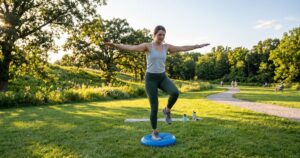
Wobble Cushion Exercises for Balance and Rehabilitation
Wobble cushions are one of the most versatile and cost-effective pieces of rehabilitation equipment available. A single cushion can be used for ankle and knee rehab, fall prevention, postural training, and core activation across a wide range of patient populations and settings. This guide covers the main wobble cushion exercises used in clinical practice, how to progress them through a rehabilitation programme, and practical notes for prescribing home use.
Why wobble cushions work
The air-filled unstable surface challenges the proprioceptive system, the network of receptors in muscles, joints, and tendons that feeds information about position and movement to the central nervous system. After injury, particularly to the ankle or knee, proprioception is frequently compromised even after strength has returned. This is one reason re-injury rates are high without specific neuromuscular rehabilitation.
A wobble cushion provides a low-cost, adjustable instability stimulus that can be introduced early in rehabilitation and progressed incrementally. Air pressure can be adjusted to vary the challenge, and the seated-to-standing transition makes it useful at multiple stages of recovery.
 |
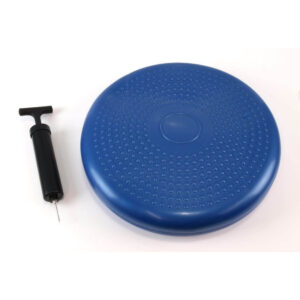 |
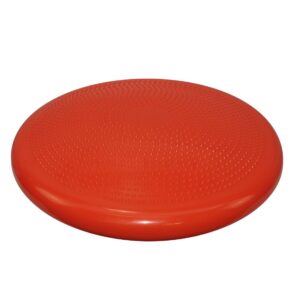
| Large Wobble Cushion - 55cm diameter | Wobble Cushion 33cm Diameter |
Core wobble cushion exercises
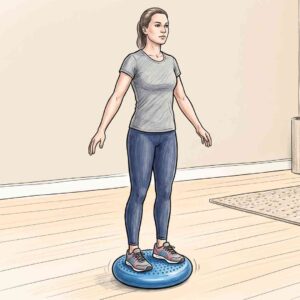 |
Standing balance (two-legged)The starting point for most patients. When standing with both feet on the cushion, the goal is to maintain a steady, upright posture without holding onto a support. A few key points: feet hip-width apart, soft knees, gaze fixed on a point at eye level. Progression: Eyes closed. This removes visual compensation and increases reliance on proprioceptive and vestibular input. Starting target: 30–60 seconds, two to three sets. |
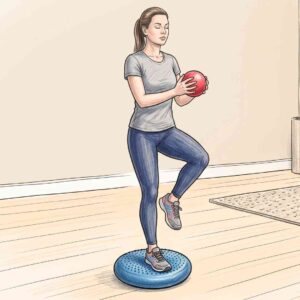 |
Single-leg stanceOnce two-legged balance is controlled, progress to standing on one foot. The challenge increases substantially, particularly useful for ankle rehab and lower limb post-operative recovery. Progression: Eyes closed. Introduce a light task (catching a ball, turning the head) to replicate the dual-task demands of functional movement. Starting target: 15–30 seconds each side, two to three sets. |
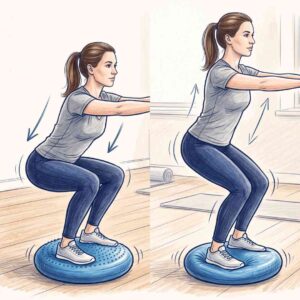 |
Squat and mini-squatStanding on the wobble cushion, perform shallow knee bends. The instability challenges the quadriceps, glutes, and ankle stabilisers simultaneously. Particularly useful in knee rehabilitation following ligament injury or replacement. Keep the knee tracking over the second toe and avoid excessive forward lean of the trunk. Do not progress to this until single-leg static balance is well established. |
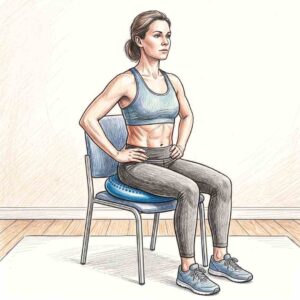 |
Seated core activationPlace the wobble cushion on a chair and have the patient sit on it during clinic exercises or rest. The unstable surface activates deep spinal stabilisers and improves postural awareness passively. Useful as an adjunct for lumbar spine rehabilitation or as a way to accumulate neuromuscular training time during everyday activity. |
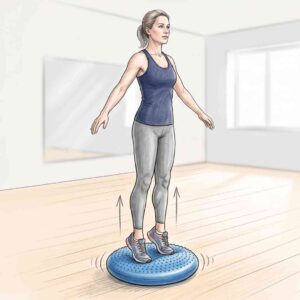 |
Calf raise on cushionStanding on the wobble cushion, perform slow heel raises. The instability adds a proprioceptive challenge to what would otherwise be a simple calf exercise. Particularly useful in the later stages of ankle rehabilitation. |
Progression framework
Balance training responds well to progressive overload, but the progressions are not about adding weight; they're about increasing complexity.
Stage 1: Two-legged stance, eyes open, flat surface → cushion
Stage 2: Two-legged stance, eyes closed on cushion
Stage 3: Single-leg stance, eyes open on cushion
Stage 4: Single-leg stance, eyes closed on cushion
Stage 5: Single-leg stance with task (catching, head turns, reaching)
Stage 6: Dynamic movement on cushion (mini-squat, calf raise, lateral shift)
Not all patients reach all stages. The goal is to work to the appropriate level for their presentation and functional demands.
Fall prevention in older adults
Wobble cushions are increasingly used in falls prevention programmes for older patients. The proprioceptive stimulus is gentle enough for frail patients when pressure is reduced, and the cushion format is less intimidating than a balance board.
Key considerations when prescribing for older patients: ensure a stable support (chair or wall) is within reach, start with seated use before progressing to standing, and keep sessions shorter and more frequent rather than long and infrequent.
Prescribing for home use
Wobble cushions are inexpensive enough for home purchase, which makes them well suited to home exercise programme (HEP) prescription. A few practical notes:
- Demonstrate proper setup and inflation level at the clinic before the patient takes the cushion home
- Provide clear written instructions alongside the cushion — a printed exercise sheet reduces guesswork and improves compliance
- Advise patients to perform exercises near a wall or sturdy surface for safety, particularly in the early stages
Browse wobble cushions at trimbio — 33cm and 55cm options available.
Related guides
- Wobble cushion exercises for ankle rehabilitation — specific protocols for ankle sprain and instability
- Wobble cushion vs balance board: which is right for your patients? — a comparison for clinicians
Sources:
Physiopedia — Balance Boards: clinical applications, fall prevention, lower limb rehabilitation
Physiopedia — Functional Sequence of Balance Training Exercises
Physiopedia — Proprioception of the Ankle
Physiopedia — Proprioception (general)
Journal of Sport Rehabilitation — Wobble board rehabilitation for improving balance in ankles with chronic instability (Linens et al., 2016) — search "Linens wobble board chronic ankle instability 2016"