


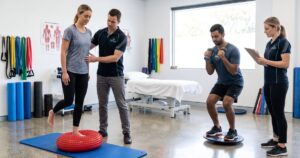
Wobble Cushion vs Balance Board: Which Is Right for Your Patients?
Both wobble cushions and balance boards are used for proprioceptive and balance training, but they're not interchangeable. Each has different characteristics that make it more or less appropriate depending on the patient, the clinical presentation, and the stage of rehabilitation.
Here's a straightforward comparison to help with prescription decisions.
How they differ
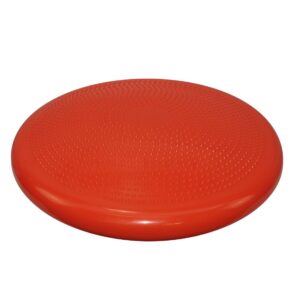
A wobble cushion is an air-filled inflatable disc, typically 33–36cm in diameter. The instability it provides is multi-directional and relatively forgiving; the cushion deforms gradually under load, which limits how far the ankle or foot can shift in any one direction. The challenge level can be adjusted by changing the inflation pressure.
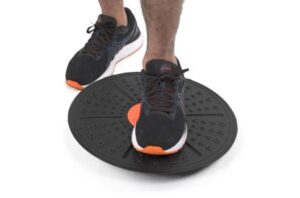
A balance board (or wobble board) is a rigid platform mounted on a fulcrum. The instability is more pronounced, and the movement arc is larger. There is a genuine tipping point that the patient must control. Most balance boards have a fixed challenge that can't be adjusted.
When to choose a wobble cushion
Earlier in rehabilitation.The lower amplitude instability is appropriate for patients who are still building confidence and basic ankle strength. Less risk of a sudden loss of balance. Older patients or those with balance impairment.The gentle, gradual instability of the cushion is less threatening than a balance board. It can also be used seated, which the balance board cannot. Home use.Wobble cushions are cheaper, lighter, and less likely to cause an injury if a fall occurs. They're well suited to unsupervised home exercise. Multi-application use.As well as standing balance work, the wobble cushion can be used seated on a chair useful for core and postural training in patients who can't yet bear weight. |
 |
When to choose a balance board
Later in rehabilitation.Once proprioceptive deficits have begun to resolve and the patient can control single-leg stance on a cushion with eyes closed, the balance board offers a meaningful progression. Active or sporty patients.For athletes returning to sport, the more demanding instability of a balance board more closely replicates the dynamic challenges of their activity. Specific mediolateral training.A balance board with a directional fulcrum can be used to target lateral ankle stability specifically, which is useful following lateral ligament injury. |
 |
The practical answer for most clinics
For the majority of clinical presentations, ankle rehab, post-op lower limb recovery, fall prevention, and general balance work, a wobble cushion covers more ground than a balance board and is more versatile across patient populations.
If you see a significant volume of sports rehabilitation or later-stage balance retraining, having both available makes sense. The cushion handles the early and mid-phases; the board provides a progression endpoint.
Browse wobble cushions at trimbio
Related guides: Wobble cushion exercises for rehabilitation | Wobble cushion ankle rehabilitation protocol