

Free Delivery over £75 ex VAT
*Excl. Reconditioned Equipment & Medical Furniture

Payment Options Available
We accept Klarna, VISA, Mastercard & AMEX

UK Offices & Warehouse
Dispatched within 2 days. Next-day upgrade:£2.99+VAT

Proud Supplier to the NHS
To Trusts across the United Kingdom
Ferrules

Ferrules
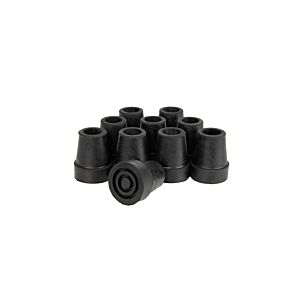
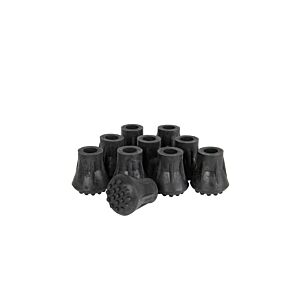
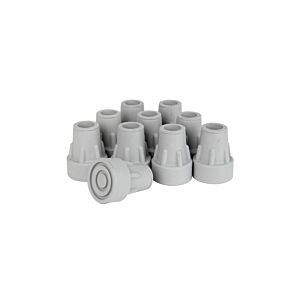
Our walking stick crutch ferrules provide essential grip, stability, and safety by creating a non-slip base on a variety of surfaces. Also known as stick ferrules or rubber ends, they help prevent slips, absorb shock for added comfort, protect floors, and replace worn tips. Available in multiple shapes and sizes, they offer improved traction to suit different crutches and user needs.

How to choose the right walking stick ferrule
Most ferrules are sold by the internal diameter of the stick or crutch shaft, commonly 16mm, 19mm and 22mm. In comparison with shape, size matters most; an oversized ferrule can spin around or slip off the shaft, and an undersized ferrule will not be able to fit all surfaces. You are advised to determine the circumference of the shaft before purchasing a ferrule.
Standard vs bell-shaped ferrules
There are two main types of walking stick ferrules in general use. Ferrules that are standard in nature are straight and cylindrical in shape and are well suited to everyday walking sticks and canes that require just one point support. Ferrules that are bell shaped have a wider and flared base which provides better support area and increased stability on rough surfaces as well as confidence to those users that require additional support while walking.
Why ferrules wear out and when to replace them
Since the ferrule is the part that absorbs every shock from each step you take, it is the part that will deteriorate first on your cane or crutch. Look out for the following indications that the ferrule needs replacement: smooth and worn-out tread, cracked rubber, or any wobbling at the bottom. Rehabilitation and physiotherapy teams issuing walking aids often keep a stock of ferrules on hand so aids can be quickly refitted between patients.
Ordering for clinics and organisations
trimbio supplies ferrules individually or in bulk to NHS Trusts, private physiotherapy clinics, care homes, and community equipment services across the UK. If you're stocking up for a department or need a specific diameter that isn't listed, contact the team and we can advise on availability. Orders over £75 ex VAT qualify for free UK delivery, dispatched within 2 working days, wherever in the UK you're based.
Ferrules are part of our wider aids for daily living range, alongside walking sticks and crutches. In case you are looking at wider options, all products under physiotherapy and rehabilitation equipment can be found on our dedicated pages.
Frequently Asked Questions On Walking Stick Ferrules
What is a ferrule on a walking stick?
Ferrule is made of rubber and is fixed at the bottom end of a walking stick or crutch. It provides grip to the ground surface, lessens shock at every step and ensures protection of the crutch as well as the floor.
What is the correct size of ferrule that I should get?
The size of the ferrule is determined by the inner diameter of the hole of the stick. The ferrule could be 16mm, 19mm, or 22mm. It is important to measure the diameter of the stick at its base.
What is the difference between the standard and bell-shaped ferrule?
Standard type of ferrule is considered standard since it is designed in such a way that it can be used comfortably during daily activities. Bell-type ferrule is a wider one, and its base expands, making it more stable on rough surfaces.
How often does one need to change his walking stick ferrules?
There's no fixed schedule, it depends on use. The ferrules may be checked from time to time for signs of wear on the tread, cracks, or for looseness at its base. The worn out ferrule will slip easily, hence should be changed immediately.
What are the signs that a ferrule needs replacement?
Signs a ferrule needs replacing. The main visual cue is wear on the tread pattern. Most ferrules have ridged or grooved rubber on the base for grip, and once that pattern is smoothed flat or worn at an angle, traction drops significantly, especially on wet or shiny floors. Other warning signs include visible cracking, splitting, or perishing of the rubber (common as it ages, even with light use), a loose fit where the ferrule wobbles or spins on the stick's shaft rather than staying snug, and any tearing near the rim that lets water or grit inside, which speeds up internal wear on the metal tip underneath. If you ever notice the stick feeling less stable, slipping unexpectedly, or making a "clicking" sound from metal touching the ground, that's a strong sign the ferrule has worn through and needs immediate replacement, since a compromised ferrule is a real fall risk.
Where can I buy walking stick ferrules in the UK?
trimbio supplies walking stick and crutch ferrules UK-wide, with free delivery over £75 ex VAT and dispatch within 2 working days. As an NHS-approved supplier, we also support bulk orders for clinics, care homes, and community equipment services.
Ferrules play a vital role in the safety and stability of walking sticks and crutches. By providing better traction, shock absorption, and adaptability to various surfaces, ferrules significantly reduce the risk of accidents, contributing to a safer experience for users navigating their environments. Regular maintenance and proper selection of ferrules ensure continued effectiveness, further enhancing user safety.